


Sk Tofajjen Hossain
Assistant Professor
Department: Department of MicrobiologyPhone Number: 7001902413
Educational Qualifications:
M.Sc.; Ph.D.
Research Area:Research of our laboratory focuses on microbial molecular biology, antimicrobial resistance, bacterial pathogenesis, and environmental microbiology. The major emphasis is on understanding the molecular mechanisms governing biofilm formation, quorum sensing, small RNA-mediated gene regulation, and virulence in clinically important pathogens, particularly Pseudomonas aeruginosa and Staphylococcus aureus. Our work also explores combinatorial antimicrobial therapies, nanoparticle-based drug delivery, and antibiofilm strategies, arsenic-oxidizing bacteria for bioremediation and sustainable agriculture, as well as RNA metabolism and ribonuclease function, integrating molecular microbiology with translational and environmental applications.
Research Overview:
My research is cantered on microbial molecular biology, antimicrobial resistance, bacterial pathogenesis, and environmental microbiology, with the overarching goal of understanding the molecular mechanisms that govern microbial survival and developing innovative strategies to combat infectious diseases and environmental contamination.
A major focus of my research is the molecular regulation of biofilm formation and virulence in clinically important bacterial pathogens, particularly Pseudomonas aeruginosa and Staphylococcus aureus. My laboratory investigates quorum sensing (QS)-mediated regulatory networks and the role of bacterial small regulatory RNAs (sRNAs) in controlling biofilm development, stress adaptation, metabolism, and pathogenicity. Through the characterization of novel sRNAs, including srbA, PA0730.1, and PA3299.1, we have uncovered previously unknown regulatory mechanisms involving key global regulators such as algU, mucA, rpoS, rsmA, and genes associated with central metabolism and virulence. These studies provide new insights into post-transcriptional regulation in bacterial pathogens and identify promising molecular targets for antimicrobial intervention.
Another important research direction involves the development of anti-virulence and antibiofilm therapies that circumvent conventional antibiotic resistance. My work has demonstrated that natural phytochemicals, including trigonelline and naringin, significantly attenuate quorum sensing, biofilm formation, and virulence traits in P. aeruginosa and S. aureus. More recently, we have expanded these studies by developing nanoparticle-based therapeutic approaches, demonstrating that silibinin-loaded BSA nanoparticles synergize with gentamicin to enhance antimicrobial efficacy through quorum sensing inhibition. These investigations integrate microbiology, molecular biology, nanotechnology, and drug delivery to establish effective combinatorial therapeutic strategies against multidrug-resistant bacterial infections.
My research also addresses environmental microbiology and sustainable bioremediation. I have isolated and characterized arsenite [As(III)]-oxidizing bacteria possessing plant growth-promoting attributes for application in arsenic-contaminated agricultural soils. These studies contribute to understanding microbial arsenic detoxification mechanisms and support the development of environmentally sustainable approaches for improving crop productivity while mitigating arsenic contamination.
Earlier in my career, I investigated the molecular basis of RNA metabolism by elucidating the helicase-dependent mechanism of RNase R function and structured RNA degradation. These studies provided fundamental insights into bacterial RNA processing and quality control. I also explored the toxicological effects of engineered metal nanoparticles, particularly cadmium oxide and cadmium sulfide nanoparticles, on bacterial and mammalian cells, revealing their impacts on cell division, oxidative stress, and cellular morphology.
Collectively, my research integrates molecular microbiology, bacterial regulatory biology, antimicrobial discovery, nanomedicine, and environmental biotechnology to address pressing challenges associated with antimicrobial resistance, persistent bacterial infections, and environmental pollution. The long-term objective of my research program is to translate fundamental mechanistic discoveries into innovative therapeutic and biotechnological solutions that improve human health, environmental sustainability, and agricultural resilience.
Assistant Professor: Department of Microbiology, University of Kalyani, Kalyani – 741235 (12.07.2018 – Present)
Assistant Professor: Department of Microbiology, Vivekananda Mahavidyalaya, Burdwan – 713103 (03.11.2016 – 11.07.2018)
Research Experience:
Postdoctoral Associate: Miller School of Medicine, University of Miami, Florida, USA (14.04.2014 – 10.06.2016)
Research Associate DST-PURSE: Department of Microbiology, University of Kalyani, Kalyani – 741235 (07.01.2014 – 28.03.2014)
Senior Research Fellow: Department of Chemistry, Bose Institute, Kolkata-700009 (10.11.2009 – 28.04.2010)
Junior Research Fellow: Department of Chemistry, Bose Institute, Kolkata-700009 (01.03.2006 – 15.05.2009)
1. Rakesh De, Subhasis Barik, Sk Tofajjen Hossain, Samir Kumar Mukherjee. Combinatorial antibiofilm and anti-virulence effects of silibinin-BSA nanoparticles and gentamicin against Pseudomonas aeruginosa: Insights into quorum sensing-mediated molecular mechanisms. International Journal of Biological Macromolecules. 2026; 354, 151398. https://doi.org/10.1016/j.ijbiomac.2026.151398
2. Piyali Saha, Samir Kumar Mukherjee, Sk Tofajjen Hossain. Unveiling the role of srbA sRNA in biofilm formation by regulating algU, mucA, rhlA, and rsmA in Pseudomonas aeruginosa. Biochemical Journal. 2025; 482, 641–657. https://doi.org/10.1042/bcj20240650
3. Amiya Kar, Samir Kumar Mukherjee, Sk Tofajjen Hossain. Quorum sensing mediated attenuation of biofilm formation and virulence traits in Staphylococcus aureus by trigonelline. Microbial Pathogenesis. 2025; 205, 107731. https://doi.org/10.1016/j.micpath.2025.107731
4. Amiya Kar, Samir Kumar Mukherjee, Sk Tofajjen Hossain. Regulatory role of PA3299.1 small RNA in Pseudomonas aeruginosa biofilm formation via modulation of algU and mucA expression. Biochemical and Biophysical Research Communications, 2025; 748, 151348. https://doi.org/10.1016/j.bbrc.2025.151348
5. Amiya Kar, Samir Kumar Mukherjee, Subhasis Barik, and Sk Tofajjen Hossain. Antimicrobial activity of trigonelline hydrochloride against Pseudomonas aeruginosa and its quorum-sensing regulated molecular mechanisms on biofilm formation and virulence. ACS Infectious Diseases. 2024, 10, 2, 746–762. https://doi.org/10.1021/acsinfecdis.3c00617
6. Pia Dey, Rakesh De, Debaprasad Parai, Sk Tofajjen Hossain, Samir Kumar Mukherjee. Enhanced antimicrobial activity of naringin-ciprofloxacin combination against Pseudomonas aeruginosa PAO1: Unveiling quorum-sensing mediated molecular mechanisms in biofilm formation and virulence. The Microbe. 2024, 5, 100171. https://doi.org/10.1016/j.microb.2024.100171
7. Amiya Kar, Piyali Saha, Rakesh De, Sreyashi Bhattacharya, Samir Kumar Mukherjee, and Sk Tofajjen Hossain. Unveiling the role of PA0730.1 sRNA in Pseudomonas aeruginosa virulence and biofilm formation: Exploring rpoS and mucA regulation. International Journal of Biological Macromolecules. 2024, 279, 135130. https://doi.org/10.1016/j.ijbiomac.2024.135130
8. Piyali Saha, Samir Kumar Mukherjee, and Sk Tofajjen Hossain. Regulation of TCA cycle genes by srbA sRNA: Impacts on Pseudomonas aeruginosa virulence and survival. Biochemical and Biophysical Research Communications, 2024, 737, 150520. https://doi.org/10.1016/j.bbrc.2024.150520
9. Archika Dutta, Samir Kumar Mukherjee, and Sk Tofajjen Hossain. Characterization and exploration of an As(III)-oxidizing bacterium TMKU1 for plant growth promotion under arsenic stress. The Microbe. 2024, 3, 100082. https://doi.org/10.1016/j.microb.2024.100082
10. Archika Dutta, Samir Kumar Mukherjee, and Sk Tofajjen Hossain. Characterization of As(III)-oxidizing bacteria Acinetobacter sp. TMKU7 having plant growth promoting features for possible application in arsenic-contaminated crop field. Bioremediation Journal. 2024, 28(4), 457–471. https://doi.org/10.1080/10889868.2023.2298326
11. Shamayita Basu, Archika Dutta, Samir Kumar Mukherjee, and Sk Tofajjen Hossain. Isolation and characterization of an As(III) oxidizing bacterium, Acinetobacter sp. TMKU4 from paddy field for possible arsenic decontamination. Journal of Hazardous Materials Advances. 2023, 10, 100289. https://doi.org/10.1016/j.hazadv.2023.100289
12. Shamayita Basu, Samir Kumar Mukherjee, and Sk Tofajjen Hossain. Arsenic detoxification by As (III)-oxidizing bacteria: A proposition for sustainable environmental management. Microbiology and Biotechnology Letters. 2023, 51 (1), 1-9. http://dx.doi.org/10.48022/mbl.2212.12003
13. Pia Dey, Debaprasad Parai, Sk Tofajjen Hossain, and Samir Kumar Mukherjee. The aftermath of corona virus disease on antimicrobial resistance across low- and middle-income countries. Universitas Scientiarum. 2023, 28 (2), 183-199. https://doi.org/10.11144/Javeriana.SC282.taoc
14. Pia Dey, Debaprasad Parai, Malabika Banerjee, Sk Tofajjen Hossain, and Samir Kumar Mukherjee. Naringin sensitizes the antibiofilm effect of ciprofloxacin and tetracycline against Pseudomonas aeruginosa biofilm. International Journal of Medical Microbiology. 2020, 310 (3), 151410. https://doi.org/10.1016/j.ijmm.2020.151410
15. Sk Tofajjen Hossain, and Murray P. Deutscher. Helicase activity plays a crucial role for RNaseR function in vivo and for RNA metabolism. The Journal of Biological Chemistry. 2016, 291, 9438–9443. https://doi.org/10.1074/jbc.C116.726091
16. Sk Tofajjen Hossain, Arun Malhotra and Murray P. Deutscher. How RNase R degrades structured RNA: Role of the helicase activity and the S1 domain. The Journal of Biological Chemistry. 2016, 291, 7877–7887. https://doi.org/10.1074/jbc.M116.717991
17. Sk Tofajjen Hossain, Arun Malhotra and Murray P. Deutscher. The helicase activity of ribonuclease R is essential for efficient nuclease activity. The Journal of Biological Chemistry. 2015, 290, 15697–15706. https://doi.org/10.1074/jbc.M115.650176
18. Ivy Mallick, Sk Tofajjen Hossain, Sangram Sinha, and Samir Kumar Mukherjee. Brevibacillus sp. KUMAs2, a bacterial isolate for possible bioremediation of arsenic in rhizosphere. Ecotoxicology and Environmental Safety. 2014, 107, 236-244. https://doi.org/10.1016/j.ecoenv.2014.06.007
19. Sk Tofajjen Hossain and Samir Kumar Mukherjee. Toxicity of cadmium sulfide (CdS) nanoparticles against Escherichia coli and HeLa cells. Journal of Hazardous Materials. 2013, 260, 1073–1082. https://doi.org/10.1016/j.jhazmat.2013.07.005
20. Sk Tofajjen Hossain, Prasenjit Das and Samir Kumar Mukherjee. Toxicity of cadmium nanoparticles to Bacillus subtilis. Toxicological & Environmental Chemistry. 2013, 95(10), 1748–1756. https://doi.org/10.1080/02772248.2014.907902
21. Sudipta Pathak, Kamalesh Debnath, Sk Tofajjen Hossain, Samir Kumar Mukherjee, and Animesh Pramanik. Synthesis of biologically important phthalazinones, 2,3-benzoxazin-1-ones and isoindolinones from ninhydrin and their antimicrobial activity. Tetrahedron Letters. 2013. 54 (24), 3137-3143. https://doi.org/10.1016/j.tetlet.2013.04.015
22. Sk Tofajjen Hossain and Samir Kumar Mukherjee. CdO nanoparticle toxicity on growth, morphology, and cell division in Escherichia coli. Langmuir. 2012, 28(48), 16614–16622. https://doi.org/10.1021/la302872y
23. Sk Tofajjen Hossain, Ivy Mallick, Samir Kumar Mukherjee. Cadmium toxicity in Escherichia coli: Cell morphology, Z-ring formation and intracellular oxidative balance. Ecotoxicology and Environmental Safety. 2012, 86, 54–59. https://doi.org/10.1016/j.ecoenv.2012.09.017
1. Archika Dutta, Samir Kumar Mukherjee, and Sk Tofajjen Hossain. Microbial fuel cell assisted wastewater treatment: A review on current trends. In: Shah, M.P. (eds). Microbial Technologies in Industrial Wastewater Treatment. 2023, Springer, Singapore. https://doi.org/10.1007/978-981-99-2435-6_5
2. Sumita Mondal, Samir Kumar Mukherjee, and Sk Tofajjen Hossain. Exploration of plant growth promoting rhizobacteria (PGPRs) for heavy metal bioremediation and environmental sustainability: Recent advances and future prospects. In: Shah, M.P. (eds). Modern Approaches in Waste Bioremediation. 2023, Springer, Cham. https://doi.org/10.1007/978-3-031-24086-7_3
3. Amit K. Paul, Samir K. Mukherjee, and Sk Tofajjen Hossain. Chapter 23 – Application of nanomaterial in wastewater treatment: recent advances and future perspective. In: Maulin Shah, Susana Rodriguez-Couto, Jayanta Biswas (eds). Development in Wastewater Treatment Research and Processes. 2022, Elsevier, 515-542. https://doi.org/10.1016/B978-0-323-85583-9.00003-X
4. Subhabrata Ghosh, Jayanta Sikdar, Samir K. Mukherjee, and Sk Tofajjen Hossain. Chapter 13 – Use of bioprospecting approach to reveal the potential of various algal species for value added compounds. In: Maulin Shah, Susana Rodriguez-Couto, Celia Bertha Vargas De La Cruz, Jayanta Biswas (eds). An Integration of Phycoremediation Processes in Wastewater Treatment. 2022, Elsevier, 271-288. https://doi.org/10.1016/B978-0-12-823499-0.00013-4
5. Archika Dutta, Shamayita Basu, Samir Kumar Mukherjee, and Sk Tofajjen Hossain. Chapter 21 – Wastewater treatment by microbial biofilm: A distinct possibility. In: Maulin Shah, Susana Rodriguez-Couto (eds). Microbial Ecology of Wastewater Treatment Plants. 2021, Elsevier, 435-468. https://doi.org/10.1016/B978-0-12-822503-5.00013-8
6. Shamayita Basu, Archika Dutta, Samir Kumar Mukherjee, and Sk Tofajjen Hossain. Chapter 9 – Exploration of green technology for arsenic removal from groundwater by oxidation and adsorption using arsenic-oxidizing bacteria and metal nanoparticles. In: Maulin P Shah, Susana Rodriguez Couto, Vineet Kumar (eds). New Trends in Removal of Heavy Metals from Industrial Wastewater. 2021, Elsevier, 177-211. https://doi.org/10.1016/B978-0-12-822965-1.00009-X
7. Ivy Mallick, Sk Tofajjen Hossain, Sangram Sinha, and Samir Kumar Mukherjee. Use of indigenous bacteria from arsenic contaminated soil for arsenic bioremediation. In: Raju, N., Gossel, W., Sudhakar, M. (eds) Management of Natural Resources in a Changing Environment. 2015, Springer, Cham. https://doi.org/10.1007/978-3-319-12559-6_11
| Sl. No | Name | Photo | Current Status |
|---|---|---|---|
| 1 | Archika Dutta |
Awarded |
|
| 2 | Shamayita Basu |
Awarded |
|
| 3 | Piyali Saha |
Awarded |
|
| 4 | Rakesh De |
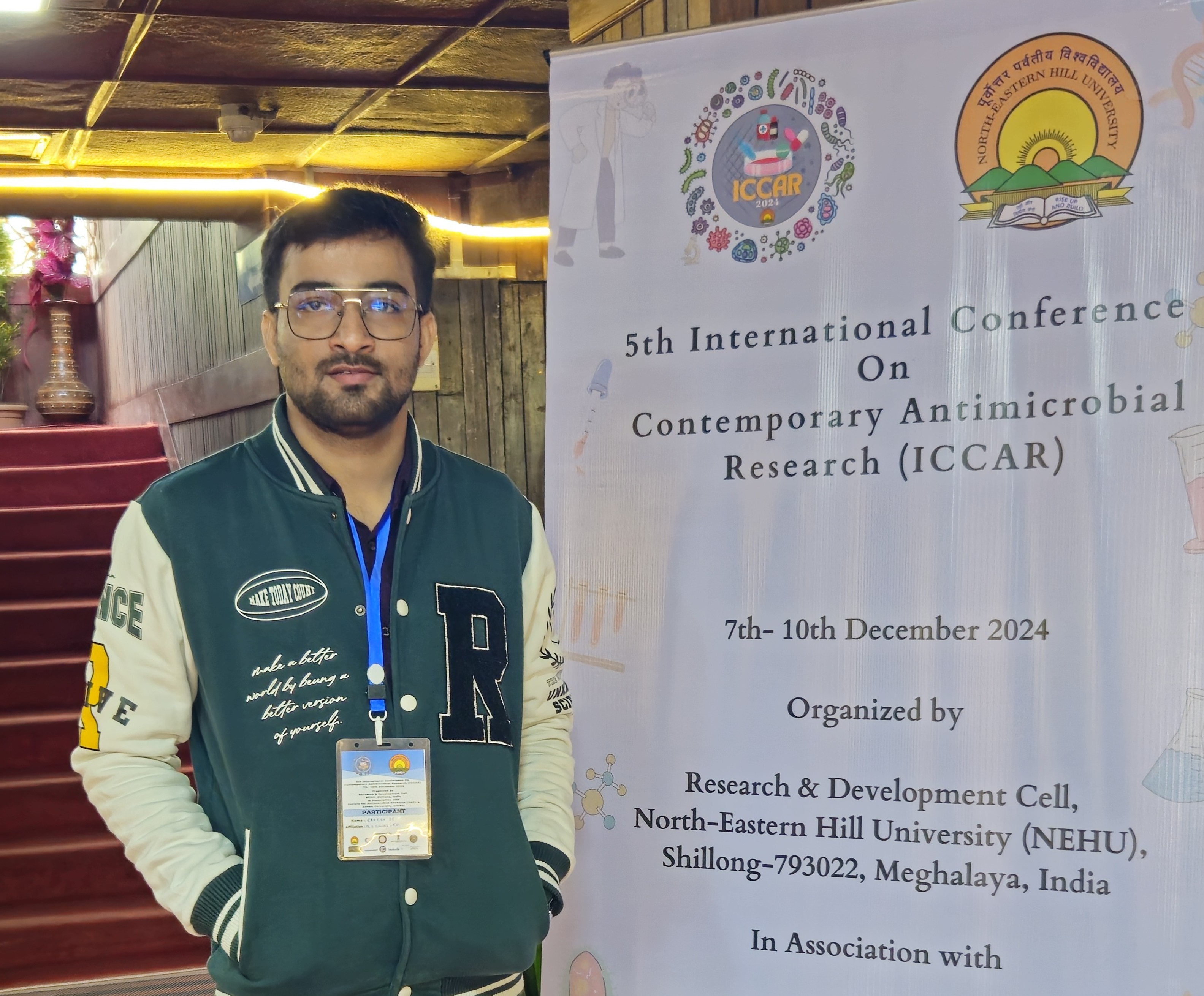
|
Ongoing (Exploration of phytochemicals and its nano-formulations as antibiofilm and antivirulence agent against Pseudomonas aeruginosa and elucidation of its quorum sensing regulated molecular targets). |
| 5 | Amiya Kar | ||
| 6 | Arpita Bhabani | ||
| 7 | Tamalika Mistry |

|
Ongoing (Unveiling the role of small RNA in regulating quorum sensing, biofilm formation, virulence and stress responses in Pseudomonas aeruginosa) |